Extended Plots & Diagnostics
Extended plots (templates)
dartwork-mpl ships ready-to-use plot templates in dartwork_mpl.templates
for chart types that are tedious to build from scratch but show up
constantly in real reports:
import numpy as np
from dartwork_mpl.templates import plot_diverging_bar

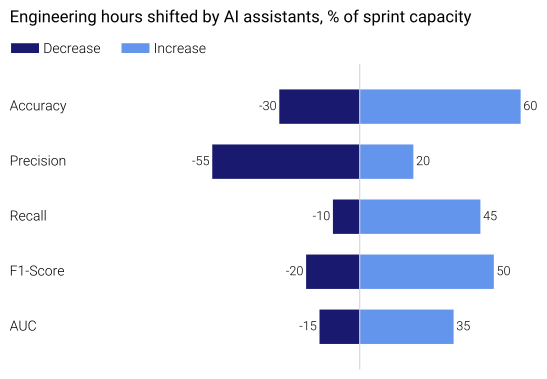
fig, ax = plot_diverging_bar(
    labels=["Accuracy", "Recall", "F1-Score"],
    neg_values=np.array([-30, -55, -10]),
    pos_values=np.array([60, 20, 45]),
    neg_label="Decrease",
    pos_label="Increase",
)
The templates module is intentionally narrow — it grows only when a
chart pattern repeats across enough projects to deserve a curated
default. See API › Extended Plots for the full
parameter list.
Diagnostics & previews (diagnostics)
Asset-inspection helpers live in dartwork_mpl.diagnostics; dm.show_colors
covers the Model B color-family preview directly. Use them to audit exactly
what your environment has registered — fonts, color libraries, and curated
colormaps — before you commit to a chart.
import dartwork_mpl as dm
from dartwork_mpl import diagnostics

# 1. What Model B families are available?
dm.show_colors(kind="qualitative")

# 2. Which colormaps does dartwork-mpl bundle, by category?
diagnostics.render_cmap_catalog(group_by_type=True, ncols=4)

# 3. Are my fonts registered? (sanity-check Korean/CJK installs)
dm.plot_fonts(font_size=11, ncols=3)

# 4. What category does an arbitrary colormap belong to?
import matplotlib as mpl
print(diagnostics.classify_cmap(mpl.colormaps["coolwarm"]))  # → "Diverging"
Note
Looking for the full palette? The interactive, copy-on-click swatch grid (140+ OpenColor / Tailwind / Material colors with search) lives on the dedicated Color System → Palette Catalog page. The diagnostic helpers above are aimed at programmatic sanity checks; the catalog page is the place to browse.
Tip
Lightweight discovery. If you only need a list (not a full preview figure),
use dm.list_colors(); if you need the actual colors, call
dm.colors("blue", n=5) or dm.colors("aurora").
>>> [record["name"] for record in dm.list_colors()[:5]]
['amber', 'blue', 'cobalt', 'coral', 'cyan']

>>> dm.colors("aurora").name
'dc.aurora'

>>> dm.show_colors(names=["blue"], n=5)   # renders a compact preview
See API › Visualization Tools for full parameter reference of the four diagnostic helpers.
See also
Next → Interactive UI — launch a local web app to tweak parameters with sliders, export plots, and generate reproducible scripts
API › Extended Plots for all
templatesfunction signaturesAPI › Visualization Tools for diagnostic plot functions