Note
Go to the end to download the full example code.
Polar Plots
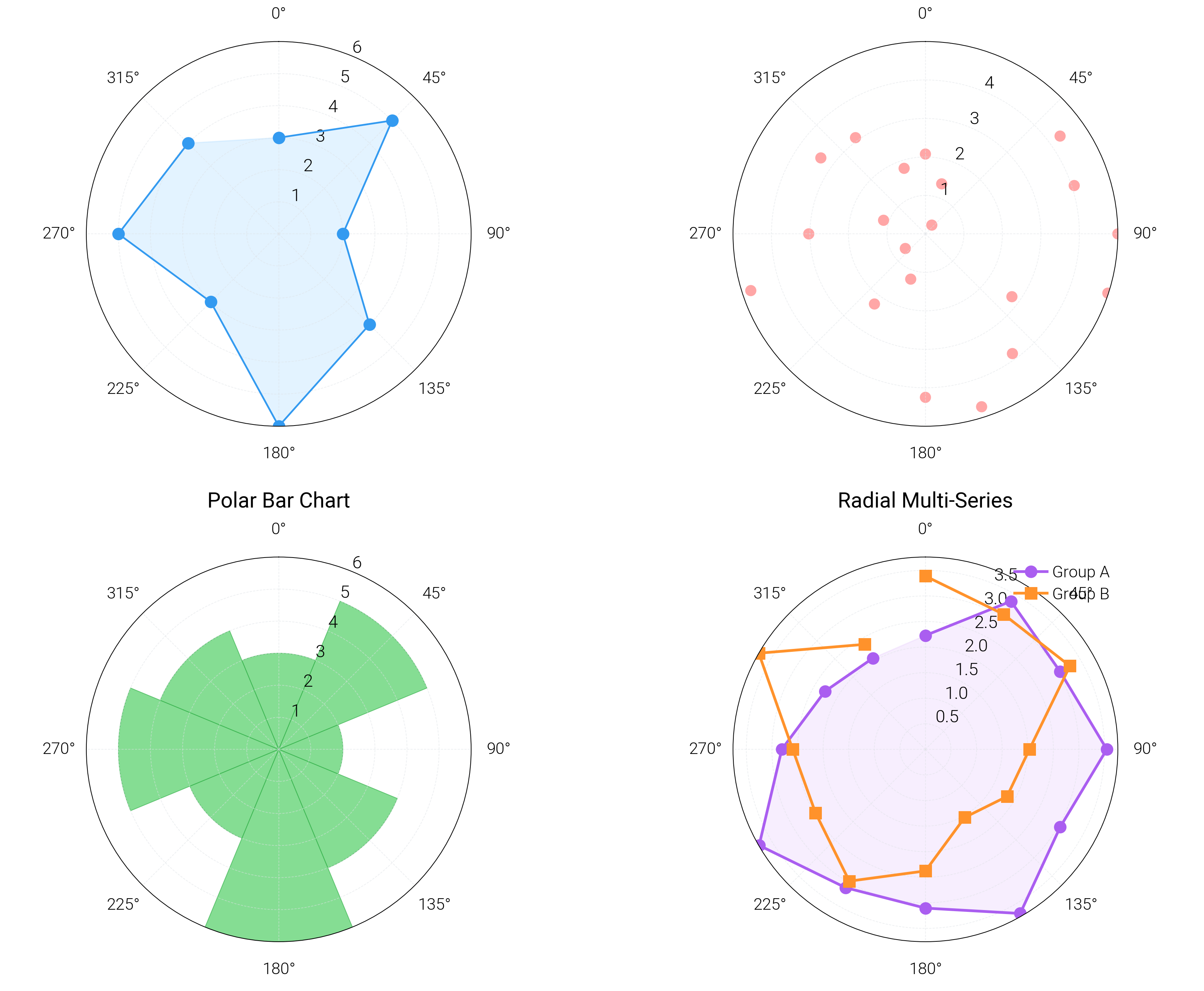
Create polar lines, scatters, and radial bars tuned for angle grids and clear radial labels.
import matplotlib.pyplot as plt
import numpy as np

import dartwork_mpl as dm

# Apply scientific style preset
# Default: font.size=7.5, lines.linewidth=0.5, axes.linewidth=0.3
dm.style.use("scientific")

# Generate sample data
theta = np.linspace(0, 2 * np.pi, 8, endpoint=False)
r1 = np.array([3, 5, 2, 4, 6, 3, 5, 4])
r2 = np.random.rand(20) * 5
theta2 = np.linspace(0, 2 * np.pi, 20, endpoint=False)

# Create figure (roomier to avoid clipped titles): ~17 cm wide, 14 cm tall
fig = plt.figure(figsize=(dm.cm2in(17), dm.cm2in(14)), dpi=300)

# Create GridSpec for 4 subplots with polar projection (2x2)
gs = fig.add_gridspec(
    nrows=2,
    ncols=2,
    left=0.07,
    right=0.95,
    top=0.96,
    bottom=0.08,
    wspace=0.16,
    hspace=0.34,
)

theta_labels_deg = np.arange(0, 360, 45)


def apply_theta_labels(ax, frac=1.04, pad=2):
    """Place all theta tick labels at a consistent distance from the rim."""
    ax.set_thetagrids(theta_labels_deg)
    ax.tick_params(axis="x", labelsize=dm.fs(-1), pad=pad)


# Panel A: Basic polar plot
ax1 = fig.add_subplot(gs[0, 0], projection="polar")
# Explicit parameters: lw=0.7, marker='o', markersize=4
ax1.plot(
    theta, r1, color="oc.blue5", lw=0.7, marker="o", markersize=4, label="Data"
)
ax1.fill(theta, r1, color="oc.blue2", alpha=0.3)
ax1.set_title("Basic Polar Plot", fontsize=dm.fs(1), pad=20)
ax1.set_theta_zero_location("N")
ax1.set_theta_direction(-1)
ax1.grid(True, linestyle="--", linewidth=0.3, alpha=0.5)
apply_theta_labels(ax1)

# Panel B: Polar scatter plot
ax2 = fig.add_subplot(gs[0, 1], projection="polar")
# Explicit parameters: s=20, alpha=0.6
ax2.scatter(theta2, r2, c="oc.red5", s=20, alpha=0.6, edgecolors="none")
ax2.set_title("Polar Scatter Plot", fontsize=dm.fs(1), pad=20)
ax2.set_theta_zero_location("N")
ax2.set_theta_direction(-1)
ax2.grid(True, linestyle="--", linewidth=0.3, alpha=0.5)
apply_theta_labels(ax2)

# Panel C: Polar bar chart
ax3 = fig.add_subplot(gs[1, 0], projection="polar")
# Explicit parameters: width=0.5, alpha=0.7, edgecolor, linewidth=0.3
width = 2 * np.pi / len(theta)
bars = ax3.bar(
    theta,
    r1,
    width=width,
    color="oc.green5",
    alpha=0.7,
    edgecolor="oc.green7",
    linewidth=0.3,
)
ax3.set_title("Polar Bar Chart", fontsize=dm.fs(1), pad=20)
ax3.set_theta_zero_location("N")
ax3.set_theta_direction(-1)
ax3.grid(True, linestyle="--", linewidth=0.3, alpha=0.5)
apply_theta_labels(ax3)

# Panel D: Multi-group radial comparison
ax4 = fig.add_subplot(gs[1, 1], projection="polar")
theta_groups = np.linspace(0, 2 * np.pi, 12, endpoint=False)
group_a = 2 + np.random.rand(len(theta_groups)) * 2
group_b = 1.5 + np.random.rand(len(theta_groups)) * 2.5
ax4.plot(
    theta_groups,
    group_a,
    color="oc.purple5",
    lw=1.1,
    marker="o",
    markersize=4,
    label="Group A",
)
ax4.plot(
    theta_groups,
    group_b,
    color="oc.orange5",
    lw=1.1,
    marker="s",
    markersize=4,
    label="Group B",
)
ax4.fill(theta_groups, group_a, color="oc.purple2", alpha=0.25)
ax4.set_title("Radial Multi-Series", fontsize=dm.fs(1), pad=20)
ax4.legend(loc="best", fontsize=dm.fs(-1))
ax4.set_theta_zero_location("N")
ax4.set_theta_direction(-1)
ax4.grid(True, linestyle="--", linewidth=0.3, alpha=0.5)
apply_theta_labels(ax4)

# Optimize layout
dm.simple_layout(fig, gs=gs)

# Show plot
plt.show()
Total running time of the script: (0 minutes 2.804 seconds)