Note
Go to the end to download the full example code.
Spectral Analysis
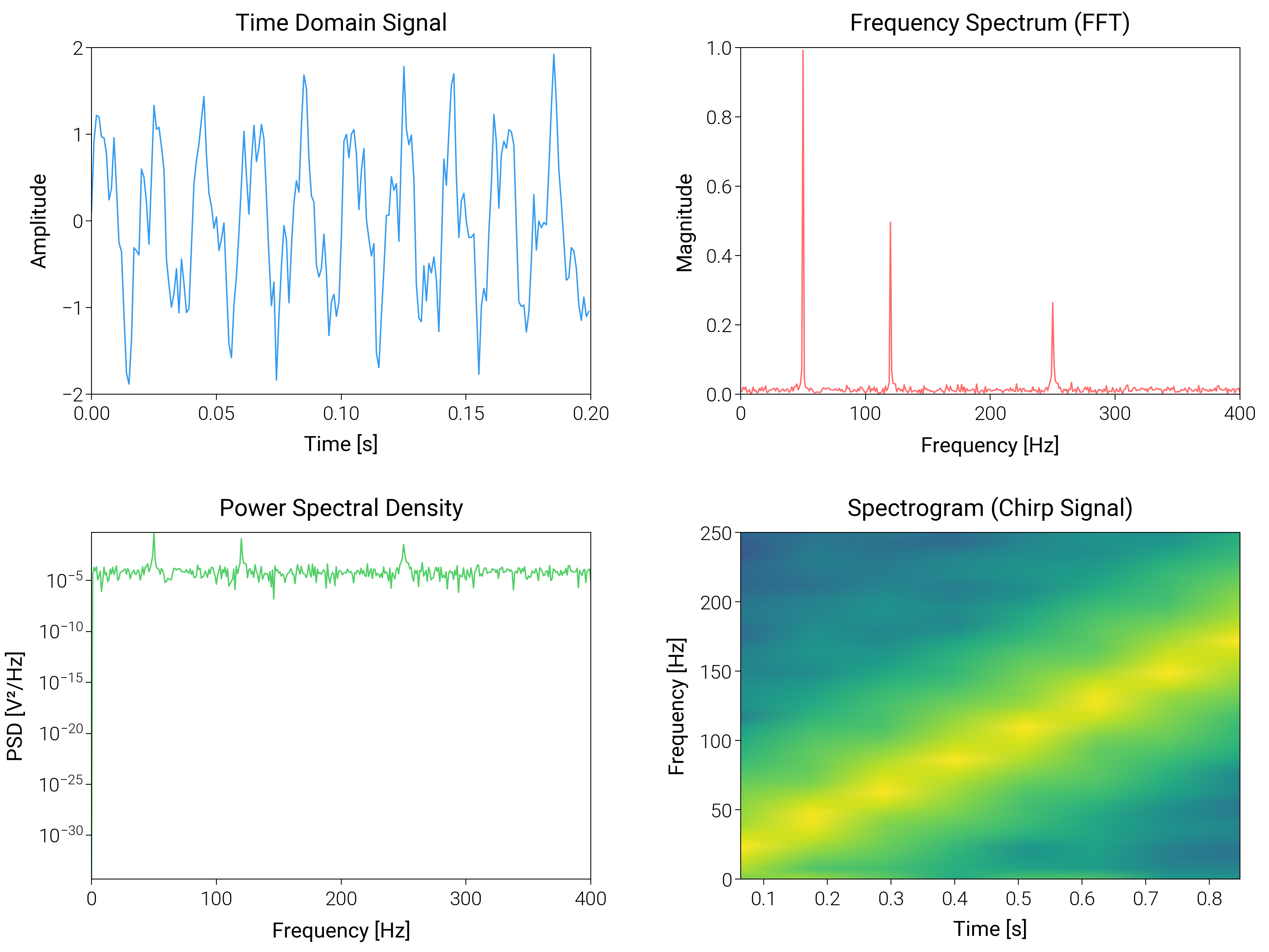
Move from signals to frequency domain with windows, PSDs, spectrograms, and labelled peaks.
import matplotlib.pyplot as plt
import numpy as np
from scipy import signal

import dartwork_mpl as dm

# Apply scientific style preset
dm.style.use("scientific")

# Generate signals
np.random.seed(42)
fs = 1000  # Sampling frequency
t = np.linspace(0, 1, fs)
# Signal with multiple frequencies
f1, f2, f3 = 50, 120, 250
signal1 = (
    np.sin(2 * np.pi * f1 * t)
    + 0.5 * np.sin(2 * np.pi * f2 * t)
    + 0.3 * np.sin(2 * np.pi * f3 * t)
)
signal_noisy = signal1 + 0.2 * np.random.randn(len(t))

# Create figure
fig = plt.figure(figsize=(dm.cm2in(16), dm.cm2in(12)), dpi=300)

# Create GridSpec for 2x2 subplots
gs = fig.add_gridspec(
    nrows=2,
    ncols=2,
    left=0.08,
    right=0.98,
    top=0.95,
    bottom=0.08,
    wspace=0.3,
    hspace=0.4,
)

# Panel A: Time domain signal
ax1 = fig.add_subplot(gs[0, 0])
ax1.plot(t[:200], signal_noisy[:200], color="oc.blue5", lw=0.5)
ax1.set_xlabel("Time [s]", fontsize=dm.fs(0))
ax1.set_ylabel("Amplitude", fontsize=dm.fs(0))
ax1.set_title("Time Domain Signal", fontsize=dm.fs(1))
ax1.set_xticks([0, 0.05, 0.1, 0.15, 0.2])
ax1.set_yticks([-2, -1, 0, 1, 2])

# Panel B: Fourier transform
ax2 = fig.add_subplot(gs[0, 1])
fft_vals = np.fft.fft(signal_noisy)
fft_freq = np.fft.fftfreq(len(signal_noisy), 1 / fs)
positive_freq = fft_freq[: len(fft_freq) // 2]
magnitude = 2 * np.abs(fft_vals[: len(fft_vals) // 2]) / len(signal_noisy)
ax2.plot(positive_freq, magnitude, color="oc.red5", lw=0.5)
ax2.set_xlabel("Frequency [Hz]", fontsize=dm.fs(0))
ax2.set_ylabel("Magnitude", fontsize=dm.fs(0))
ax2.set_title("Frequency Spectrum (FFT)", fontsize=dm.fs(1))
ax2.set_xlim(0, 400)
ax2.set_xticks([0, 100, 200, 300, 400])
ax2.set_yticks([0, 0.2, 0.4, 0.6, 0.8, 1.0])

# Panel C: Power spectral density
ax3 = fig.add_subplot(gs[1, 0])
f_psd, psd = signal.periodogram(signal_noisy, fs)
ax3.semilogy(f_psd, psd, color="oc.green5", lw=0.5)
ax3.set_xlabel("Frequency [Hz]", fontsize=dm.fs(0))
ax3.set_ylabel("PSD [V²/Hz]", fontsize=dm.fs(0))
ax3.set_title("Power Spectral Density", fontsize=dm.fs(1))
ax3.set_xlim(0, 400)
ax3.set_xticks([0, 100, 200, 300, 400])

# Panel D: Spectrogram
ax4 = fig.add_subplot(gs[1, 1])
# Create chirp signal
t_chirp = np.linspace(0, 1, fs)
chirp = signal.chirp(t_chirp, f0=10, f1=200, t1=1, method="linear")
f_spec, t_spec, Sxx = signal.spectrogram(chirp, fs, nperseg=128)
im = ax4.pcolormesh(
    t_spec, f_spec, 10 * np.log10(Sxx), shading="gouraud", cmap="viridis"
)
ax4.set_xlabel("Time [s]", fontsize=dm.fs(0))
ax4.set_ylabel("Frequency [Hz]", fontsize=dm.fs(0))
ax4.set_title("Spectrogram (Chirp Signal)", fontsize=dm.fs(1))
ax4.set_ylim(0, 250)

# Optimize layout
dm.simple_layout(fig, gs=gs)

# Save and show plot
plt.show()
Total running time of the script: (0 minutes 2.189 seconds)