Note
Go to the end to download the full example code.
Area Plots
Layer filled regions and crisp lines to highlight ranges, uncertainty bands, and stacked totals without losing clarity.
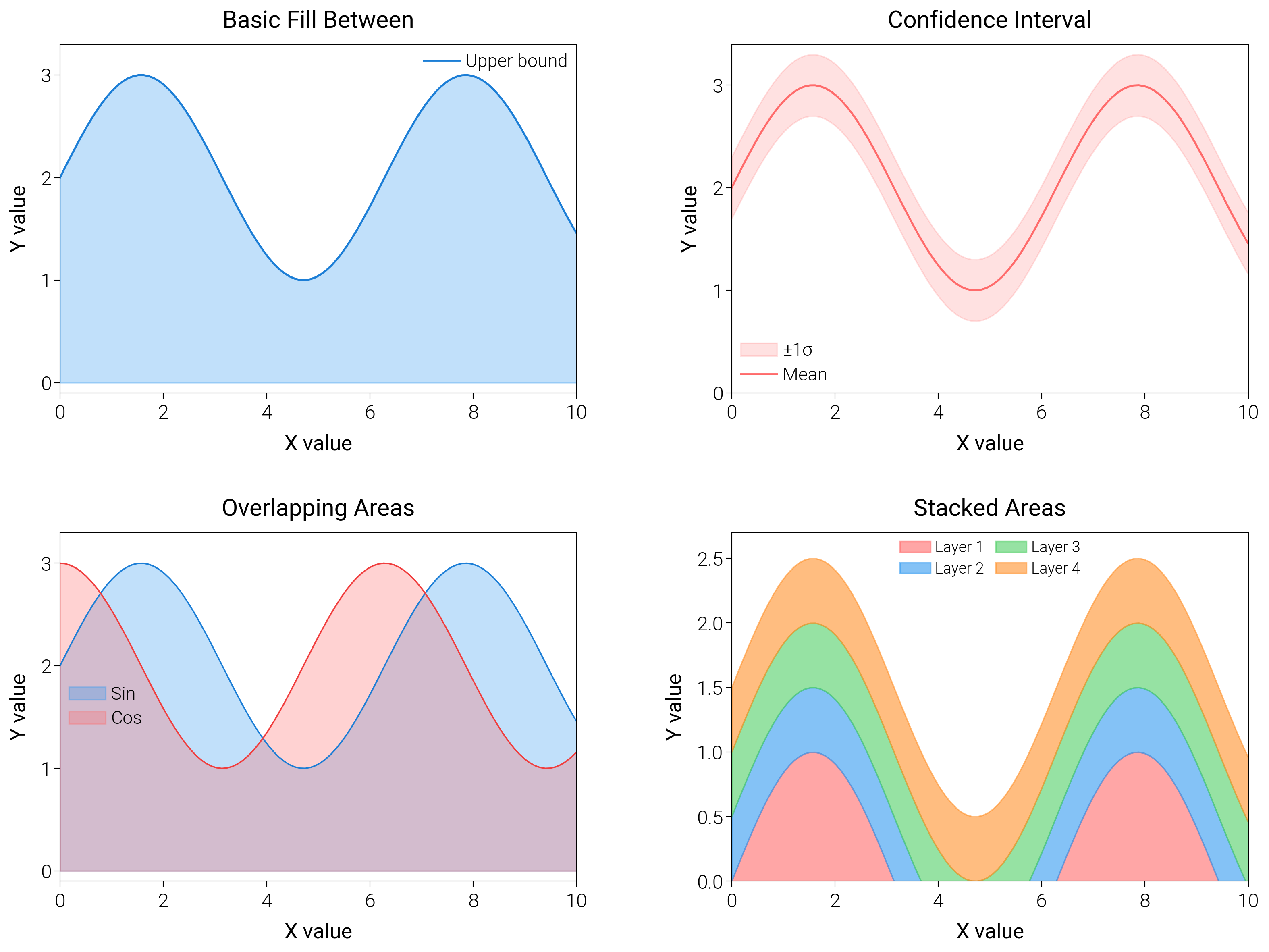
import matplotlib.pyplot as plt
import numpy as np

import dartwork_mpl as dm

# Apply scientific style preset
dm.style.use("scientific")

# Generate data
x = np.linspace(0, 10, 100)
y1 = np.sin(x) + 2
y2 = np.cos(x) + 2
y_lower = np.zeros_like(x)
y_upper1 = np.sin(x) + 3
y_upper2 = np.sin(x) + 4

# Create figure
# Double column figure: 17cm width, 2x2 layout
fig = plt.figure(figsize=(dm.cm2in(16), dm.cm2in(12)), dpi=300)

# Create GridSpec for 2x2 subplots
gs = fig.add_gridspec(
    nrows=2,
    ncols=2,
    left=0.08,
    right=0.98,
    top=0.95,
    bottom=0.08,
    wspace=0.3,
    hspace=0.4,
)

# Panel A: Basic fill_between
ax1 = fig.add_subplot(gs[0, 0])
ax1.fill_between(x, y_lower, y1, color="oc.blue5", alpha=0.3)
ax1.plot(x, y1, color="oc.blue7", lw=0.7, label="Upper bound")
ax1.set_xlabel("X value", fontsize=dm.fs(0))
ax1.set_ylabel("Y value", fontsize=dm.fs(0))
ax1.set_title("Basic Fill Between", fontsize=dm.fs(1))
ax1.legend(loc="best", fontsize=dm.fs(-1), frameon=False)
ax1.set_xticks([0, 2, 4, 6, 8, 10])
ax1.set_yticks([0, 1, 2, 3])
ax1.set_ylim(-0.1, 3.3)

# Panel B: Confidence interval style
ax2 = fig.add_subplot(gs[0, 1])
y_mean = np.sin(x) + 2
y_std = 0.3
ax2.fill_between(
    x, y_mean - y_std, y_mean + y_std, color="oc.red5", alpha=0.2, label="±1σ"
)
ax2.plot(x, y_mean, color="oc.red5", lw=0.7, label="Mean")
ax2.set_xlabel("X value", fontsize=dm.fs(0))
ax2.set_ylabel("Y value", fontsize=dm.fs(0))
ax2.set_title("Confidence Interval", fontsize=dm.fs(1))
ax2.legend(loc="best", fontsize=dm.fs(-1), frameon=False)
ax2.set_xticks([0, 2, 4, 6, 8, 10])
ax2.set_yticks([0, 1, 2, 3])
ax2.set_ylim(0, 3.4)

# Panel C: Multiple overlapping areas
ax3 = fig.add_subplot(gs[1, 0])
ax3.fill_between(x, 0, y1, color="oc.blue5", alpha=0.3, label="Sin")
ax3.fill_between(x, 0, y2, color="oc.red5", alpha=0.3, label="Cos")
ax3.plot(x, y1, color="oc.blue7", lw=0.5)
ax3.plot(x, y2, color="oc.red7", lw=0.5)
ax3.set_xlabel("X value", fontsize=dm.fs(0))
ax3.set_ylabel("Y value", fontsize=dm.fs(0))
ax3.set_title("Overlapping Areas", fontsize=dm.fs(1))
ax3.legend(loc="best", fontsize=dm.fs(-1), frameon=False)
ax3.set_xticks([0, 2, 4, 6, 8, 10])
ax3.set_yticks([0, 1, 2, 3])
ax3.set_ylim(-0.1, 3.3)

# Panel D: Stacked areas
ax4 = fig.add_subplot(gs[1, 1])
y_base = y1 - 2
y_stack1 = y_base + 0.5
y_stack2 = y_stack1 + 0.5
y_stack3 = y_stack2 + 0.5
ax4.fill_between(x, 0, y_base, color="oc.red5", alpha=0.6, label="Layer 1")
ax4.fill_between(
    x, y_base, y_stack1, color="oc.blue5", alpha=0.6, label="Layer 2"
)
ax4.fill_between(
    x, y_stack1, y_stack2, color="oc.green5", alpha=0.6, label="Layer 3"
)
ax4.fill_between(
    x, y_stack2, y_stack3, color="oc.orange5", alpha=0.6, label="Layer 4"
)
ax4.set_xlabel("X value", fontsize=dm.fs(0))
ax4.set_ylabel("Y value", fontsize=dm.fs(0))
ax4.set_title("Stacked Areas", fontsize=dm.fs(1))
ax4.legend(loc="best", fontsize=dm.fs(-2), ncol=2, frameon=False)
ax4.set_xticks([0, 2, 4, 6, 8, 10])
ax4.set_yticks([0, 0.5, 1, 1.5, 2, 2.5])
ax4.set_ylim(0, 2.7)

# Optimize layout
dm.simple_layout(fig, gs=gs)

# Save and show plot
plt.show()
Total running time of the script: (0 minutes 2.696 seconds)